
Restaurant Website Design in Pittsburgh
Menus people can read and edit yourself, on a phone, in seconds
Almost everyone arriving at a restaurant website wants one of four things: the menu, the hours, a table, or directions. A restaurant site earns its keep by answering those in seconds, on a phone, usually while the person is already hungry.
The menu is the website
More people will look at your menu than at every other page combined, and most restaurant sites still get it wrong in the same two ways.
The first is publishing the menu as a PDF or a photograph of a printed card. On a phone that means pinching and dragging to read anything, and search engines cannot read it at all, so none of your dishes exist as far as Google is concerned.
The second is that it goes out of date. Prices move, a dish comes off, the seasonal cocktail list changes, and updating it means emailing whoever built the site and waiting. So it does not get updated, and a guest arrives expecting something you stopped serving in the spring.
We build menus as real text you can edit yourself, section by section, from a browser. It stays readable on a phone, it is legible to search engines, and changing a price takes a minute.
What a restaurant site needs
Hours that are correct
On the site and on your Google listing, matching each other. The single most common reason someone ends up annoyed with a restaurant they have never visited.
Reservations in one tap
Whatever system you use, the booking path should be obvious from every page, not just the home page.
Photos of your actual food
Stock photography on a restaurant site is worse than no photography. People can tell, and it makes them wonder what else is not real.
A hiring page that works
For a restaurant this is one of the hardest-working pages on the site. Applications should arrive somewhere a manager will actually see them.
Private events and catering
Usually the highest-value inquiry a restaurant site can produce, and usually buried three levels deep or missing entirely.
Built for a phone first
Most of this traffic is somebody standing on a sidewalk deciding where to eat. That is the version to design first.
Okane, three concepts at one address
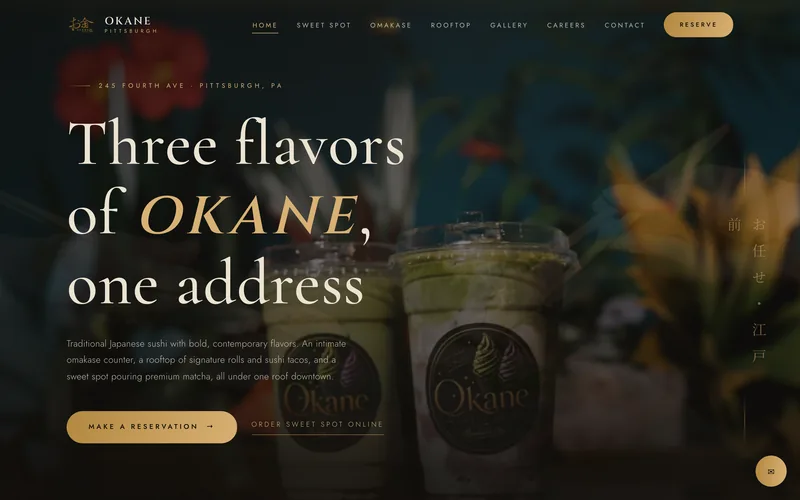
Okane is a Japanese restaurant on Fourth Avenue downtown that is really three things in one building: a sushi and omakase room, a rooftop with its own menu, and Sweet Spot, a matcha and dessert counter on the ground floor.
Three concepts under one roof is a good problem and a hard website. Visitors arrived unsure whether they were booking dinner, a rooftop table, or grabbing a matcha, and the old site did not answer that quickly.
The site now names the three up front and lets people pick. Each has its own space, its own menu and its own reservation path. Menus are structured content the restaurant edits itself, which is how a ten-wine list was added in an afternoon rather than becoming a request that waited on us.
Restaurant work
Live sites. Click through for what each had to solve.
Restaurants and hospitality we work with
A few of the places whose sites and menus we look after.






F.A.Q.
Questions restaurants ask
Can we update the menu ourselves?
Yes, and this is usually the reason people call us. You edit an item, a price or a whole section from a browser and it is live. No PDF, no waiting on anyone.
Do you work with our reservation system?
Yes. OpenTable, Resy, Tock, SevenRooms or a simple form. We build around what you already use rather than asking you to move.
What about online ordering?
If you already have a provider we integrate it. If you do not, we will talk you through what it costs, because the commission on third-party ordering is often the largest marketing expense a restaurant has without realizing it.
We have more than one location. Does that change things?
It changes the structure. Each location needs its own page, its own hours, and its own Google listing, or the two locations compete with each other in search instead of covering more ground.
How much does a restaurant website cost?
Most run from $3,000 to $10,000 depending on how many menus, locations and concepts are involved. You get a specific number after we understand the setup.
Getting the restaurant found
Most people looking for somewhere to eat tonight never reach your website first. They search, they look at the map, and they judge you on hours, photos and reviews. That is local SEO, and for a restaurant it matters more than almost anything on the site itself. We also run social media for restaurants, which is the one industry where it genuinely moves covers.
Tell us about the restaurant and what the current site does badly. We will come back with an honest assessment.