
Website Design for Nonprofits
Built for organizations run by volunteers and small teams
A nonprofit website has to survive its own staff turnover. Whatever gets built has to be cheap enough to keep online on a small budget and simple enough that a volunteer can update it two boards from now.
The real constraint is not money
Nonprofits are usually quoted as though the only issue is budget. It matters, but the harder constraint is continuity. The person who understood the website leaves, the volunteer who took the photos moves away, and two years later nobody can change the hours on the contact page.
That shapes what we build. Fewer moving parts, nothing that needs patching every month, no platform subscription quietly renewing, and an editing setup that a new volunteer can work out without training.
The alternative, which we see a lot, is a site built on something heavy that nobody maintains, and it becomes a liability inside three years.
What we build for nonprofits
Donations without friction
One obvious path to give, working on a phone, connected to whatever processor you already use. Every extra step costs donations.
Membership and renewals
Joining and renewing should not require a phone call or a printed form mailed back, which is still how a surprising number of organizations handle it.
Events people can find
Meetings, fundraisers, open days. Clear enough that somebody can work out where to be and when without emailing to check.
Archives and collections
Photographs, documents and history, presented so people can actually browse them. For a lot of organizations this is the whole reason anyone visits.
Volunteers can update it
Editing in a browser, in plain language, with no way to break the layout by accident.
Volunteers you can recruit
A page that tells somebody what helping actually involves, how much time it takes, and how to say yes. Most organizations need volunteers as badly as donations and ask for them nowhere.
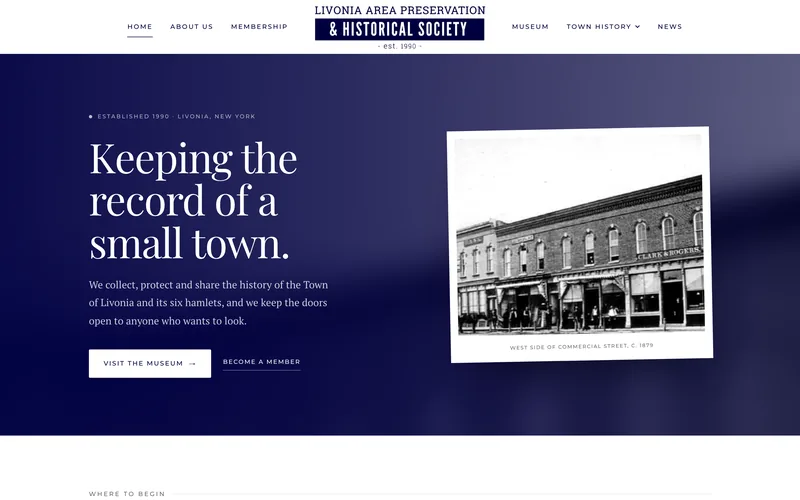
The Livonia Area Preservation and Historical Society
The Society keeps the record of a small New York town and runs a museum. It is volunteer-run, which shaped every decision.
They were on a WordPress site built with a page builder. Slow, awkward to edit, and the material that mattered most, decades of collected photographs and documents, was buried.
We rebuilt it so the archive is the design rather than an afterthought, with scans framed and captioned like plates in a book. One constraint drove a lot of it: the largest scan in their collection is under a thousand pixels wide, so blowing an image up to fill a screen would have made their best material look worst. The layout frames images at a size they can hold.
Every old web address still works, so links in newsletters going back years still land somewhere.
Nonprofit work
Live. Click through for what it had to solve.
Organizations we work with
A few of the nonprofits and community organizations whose sites we build and look after.



Who we work with
Historical societies, museums, arts organizations, community groups, foundations, advocacy organizations and neighborhood associations, across Pittsburgh and Western Pennsylvania.
We have also built and managed sites for organizations including Pittsburgh Action Against Rape, Sustainable Pittsburgh, Sweetwater Center for the Arts, Strip District Neighbors and Surgicorps International.
Being found, and being checked
Two different people look you up. Somebody searching for what you do, which is local SEO, and a funder or a prospective board member checking whether you look real before they commit. The same work serves both. If the site needs building first, that is custom website design.
F.A.Q.
Questions nonprofits ask
Do you offer nonprofit pricing?
Yes. Tell us what the organization can afford and we will tell you honestly what is achievable at that number rather than quoting a standard rate and hoping.
What will it cost to keep online?
For most of the sites we build for nonprofits, a few dollars a month in hosting and the domain renewal. There is no platform license and nothing that needs patching, which is the part that usually costs organizations money later.
Can volunteers really keep it updated?
That is the test we design for. Editing happens in a browser in plain language, and the layout cannot be broken by accident. If a new volunteer needs training to change an event date, we built it wrong.
We have a lot of scanned material. Can that go online?
Yes, and it is usually the most valuable thing an organization has. The design question is matching the presentation to what the scans can actually support, which is worth getting right before anything is built.
Can you help with grant reporting or analytics?
We set up analytics so you can report visitor numbers and what people looked at. For organizations reporting to funders that is often the first time anyone has been able to show real numbers.
Tell us about the organization and what the current site cannot do. We will come back with an honest assessment and a real number.