
Websites for Pittsburgh Contractors
Built to produce quote requests, not compliments
A contractor's website has one job. Somebody with a leaking roof or a cracked foundation should be able to find you, believe you, and reach you in under a minute. Most contractor sites fail at the third part.
What is different about contractor websites
We build for a lot of industries, and contractors are the ones where the website has the most direct effect on the phone ringing. The buying decision is high-value, urgent more often than not, and made by somebody who is nervous about being taken advantage of.
That last part shapes everything. A homeowner picking a contractor is not comparing features. They are trying to work out who is legitimate. Licensing, insurance, how long you have been trading, whether the work in the photos looks like the work they need, and whether anyone local will vouch for you.
Say all of that plainly and you have done most of the job. The sites that struggle are usually the ones burying it under paragraphs about a commitment to quality.
What we put on a contractor site
The quote form, early
Not at the bottom of the page, and not behind three clicks. On a contractor site the form should be visible where somebody lands, with a reason to start it attached.
Credentials up front
License number, insurance, years in business, manufacturer certifications. These are the things a nervous homeowner is actually scanning for.
Real project photos
Your work, not stock. A gallery the office can add to from a phone, because the job you finished last week is better proof than the one from 2019.
Pages for the towns you serve
Somebody searching for a siding contractor in Mount Lebanon is a different search from one in Cranberry. A page for each area you actually work in answers both.
Reviews where they count
Pulled onto the page near the form, not hidden on a testimonials page nobody visits.
Fast on a phone in a driveway
Half your visitors are standing outside looking at the problem. A site that takes six seconds to load has already lost them.
Two we built
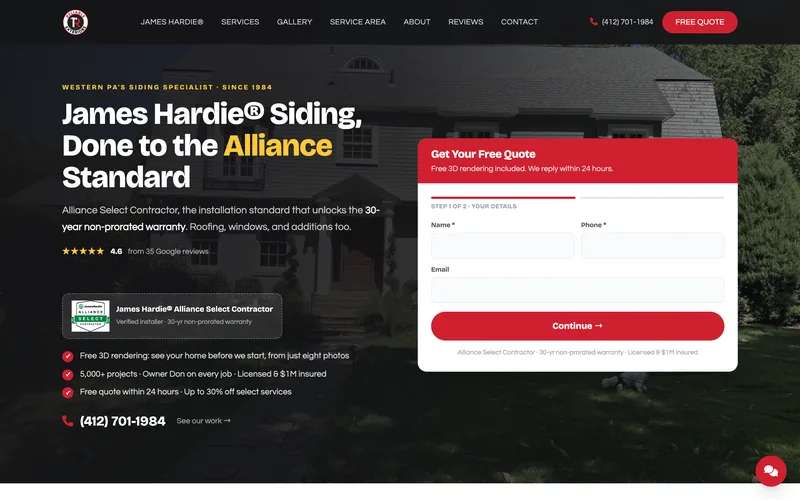
Reliable Exteriors is a family-owned siding and roofing contractor trading since 1984. Their strongest credential was one nobody had heard of: they are a James Hardie Alliance Select Contractor, which unlocks a 30-year non-prorated warranty. We led with it, explained what it means in plain words, and put a short quote form offering a free 3D rendering right where people land.
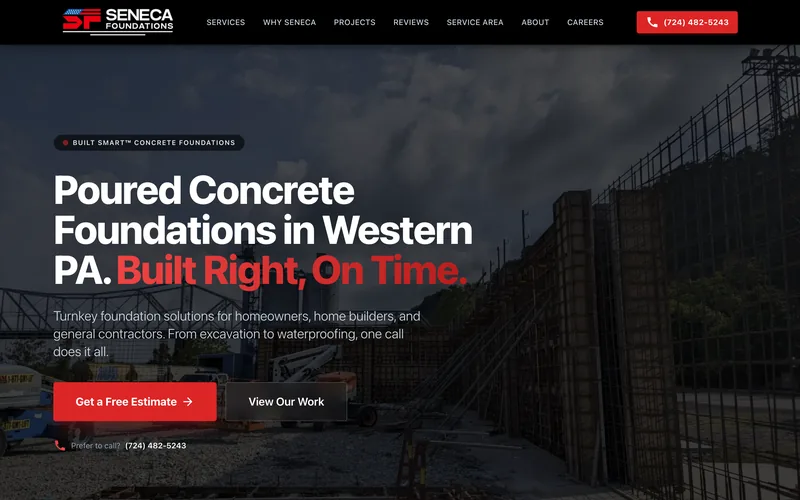
Seneca Foundations pours concrete foundations in Butler County, and sells mostly to home builders rather than homeowners. That is a different reader, so the site shows equipment, crews and finished pours, and the estimate requests feed straight into the system they already run their jobs from. It also carries a careers page, because in the trades finding crew is as hard as finding work.
Contractor sites we built
Both live. Click through for what each one had to solve.
Contractors and trades we work with
A few of the businesses whose sites we build and look after.





The trades we work with
Siding, roofing, windows, concrete and foundations, excavation, remodeling, decks, HVAC, plumbing, electrical, landscaping and paving. If your work is quoted per job and sold on trust, the site follows the same pattern regardless of the trade.
We work across Allegheny and Butler counties and the surrounding areas: the North Hills, the South Hills, Cranberry, Wexford, Mount Lebanon, Monroeville, Sewickley, Robinson, Moon and Peters Township.
Once the site is right
A good contractor site still needs to be found. Most of that is local SEO: your Google listing, your reviews, and pages for the towns you work in. If you are already on WordPress and it is creaking, we also do WordPress takeover and management. And if you want the whole thing built from scratch, that is custom website design.
F.A.Q.
Questions contractors ask us
How much does a contractor website cost?
Most run from $3,000 to $10,000 depending on how many services and service areas you need covered. You get a real number after a conversation about what the site has to do, not a range designed to get you on a call.
Will I be able to add project photos myself?
Yes, and you should. The gallery is built so the office can add a job from a phone in a couple of minutes. Recent work is the most persuasive thing on the site and it goes stale fast.
Do I need a page for every town I serve?
Not every town, but the ones you genuinely want more work in. A page per area only helps if it says something real about working there. Twenty near-identical pages with the town name swapped is a tactic Google worked out a long time ago.
What about leads that come in overnight?
Every quote request is stored the moment it arrives, then the notification goes out separately. If email hiccups, the inquiry is still there. Losing a $15,000 job to a spam filter is a bad way to find out how your form works.
How long does it take?
Four to eight weeks for most contractor sites, and the main variable is how quickly you can get us photos. Everything else we can move on without you.
Send us your web address, or tell us what you do if you have no site yet. We will come back with an honest read on what is stopping the phone from ringing.